Start Your Learning Journey Today! Only 1 day left to grab this opportunity.
 Only 15 seats left!
Don't miss
out
Only 15 seats left!
Don't miss
out
Agentic AI Engineer Bootcamp
Master the complete Agentic AI ecosystem from Python fundamentals to production-grade AI agents. Learn LLMs, RAG, LangChain, LangGraph, MCP, Multi-Agent Systems, OpenAI Agents SDK, CrewAI, n8n Automation, FastAPI, Docker, and AgentOps through hands-on projects. Build enterprise-grade AI applications including Enterprise Knowledge Assistants, SQL Agents, Data Engineering Copilots, Customer Support Agents, and Autonomous Business Automation Platforms. Designed for Data Engineers, Python Developers
 Batch
starting
Batch
starting
 Batch
size
Batch
size
 Trainer
Download PDF

Mode
Online

Duration
16 Weeks

Schedule
Weekdays 8-9 Am
Course Curriculum
Master the complete Agentic AI ecosystem from Python fundamentals to production-grade AI agents. Learn LLMs, RAG, LangChain, LangGraph, MCP, Multi-Agent Systems, OpenAI Agents SDK, CrewAI, n8n Automation, FastAPI, Docker, and AgentOps through hands-on projects. Build enterprise-grade AI applications including Enterprise Knowledge Assistants, SQL Agents, Data Engineering Copilots, Customer Support Agents, and Autonomous Business Automation Platforms. Designed for Data Engineers, Python Developers
• Python Fundamentals – Variables, Data Types, Operators, Strings, Lists, Tuples, Sets, Dictionaries & Type Casting
• Control Flow & Functions – If-Else, Loops, List Comprehensions, Functions, Lambda Functions, Map, Filter, Reduce & Recursion
• Exception Handling & Debugging – Try-Except, Finally, Custom Exceptions, Logging & Debugging Techniques
• File Processing & Data Handling – Text Files, CSV, JSON, Data Parsing & Data Transformation
• Object-Oriented Programming – Classes, Objects, Constructors, Inheritance, Polymorphism, Encapsulation & Abstraction
• Advanced Python Concepts – Iterators, Generators, Decorators & Context Managers
• API Development & JSON Processing – REST APIs, HTTP Methods, Requests Library, API Integration & JSON Handling
• Software Engineering Essentials – Git, GitHub, Virtual Environments, Package Management (pip), Project Structure & Environment Variables
• Pydantic & Data Validation – BaseModel, Validation Rules, Structured Outputs & Type Enforcement
• Introduction to AI & Generative AI – AI, Machine Learning, Deep Learning, Generative AI & Enterprise Use Cases
• Large Language Models – GPT, Gemini, Claude, Open Source Models, Model Architectures & Capabilities
• LLM Fundamentals – Tokens, Context Windows, Transformers, Attention Mechanism, Training & Inference
• Prompt Engineering – Zero-Shot, One-Shot, Few-Shot, Chain-of-Thought & Role-Based Prompting
• Advanced Prompting Techniques – ReAct, Reflection, Structured Prompting, Prompt Templates & Prompt Optimization
• Model Configuration – Temperature, Top-P, Max Tokens, Frequency Penalty & Presence Penalty
• Responsible AI – Hallucinations, Bias, Prompt Injection, AI Safety & Governance
• OpenAI, Gemini & Claude Ecosystem – APIs, Model Selection, Pricing & Enterprise Considerations
• Structured Outputs & Function Calling – JSON Outputs, Function Calling, Tool Calling & Output Validation
• Embeddings Fundamentals – Semantic Similarity, Dense Vectors, Sparse Vectors & Embedding Models
• Chunking Strategies – Fixed Chunking, Recursive Chunking, Semantic Chunking & Parent-Child Chunking
• Vector Databases – ChromaDB, FAISS, Qdrant, Pinecone Concepts & Indexing Strategies
• Similarity Search & Retrieval – Cosine Similarity, Nearest Neighbor Search & Top-K Retrieval
• Document Processing Pipelines – PDFs, Documents, Web Data & Enterprise Content Ingestion
• Metadata & Search Optimization – Metadata Filtering, Classification, Tagging & Search Relevance
• LangChain & LCEL – Chains, Retrievers, Prompt Templates, Memory & Workflow Development
• RAG & Agentic RAG – Retrieval-Augmented Generation, Agentic Retrieval, Dynamic Context & Knowledge Grounding
• Advanced Retrieval Systems – Hybrid Search, GraphRAG, Re-Ranking, Query Expansion & RAG Evaluation
• Introduction to LangGraph – Why LangGraph, LangGraph vs LangChain Agents, Agent Workflows & State Management
• Core Components – Nodes, Edges, StateGraph, Conditional Routing & Graph Execution Flow
• State Management & Memory – Shared State, Session Memory, Persistent Memory & Checkpointing
• Building Single-Agent Systems – Tool Usage, Reasoning Loops & Task Execution Patterns
• Multi-Step Agent Workflows – Sequential Processing, Decision Trees & Dynamic Routing
• Human-in-the-Loop (HITL) – Approval Workflows, Review Gates, Manual Overrides & Feedback Integration
• Agent Design Patterns – ReAct, Plan-and-Execute, Reflection & Supervisor Pattern
• Observability & Debugging – Graph Visualization, Execution Tracing, Error Handling & State Inspection
• Production Considerations – Persistence, Scalability, Retry Mechanisms & Long-Running Workflows
• MCP Fundamentals – Introduction to MCP, MCP Architecture, Clients, Servers, Resources, Tools & Prompts
• MCP Server Development – MCP SDK, Custom MCP Servers, Resources, Tool Registration & Prompt Templates
• Enterprise Tool Integration – Database MCP, GitHub MCP, File System MCP, API Integration & Business System Connectivity
• MCP Security & Governance – Authentication, Authorization, Access Control, Auditability & Enterprise Security Patterns
• MCP with Agent Frameworks – LangGraph Integration, LangChain Integration, Tool Discovery & Dynamic Tool Usage
• Multi-Agent Fundamentals – Single Agent vs Multi-Agent Systems, Agent Roles, Collaboration Models & Task Decomposition
• Agent Design Patterns – Supervisor Pattern, Swarm Pattern, Pipeline Pattern, Planner-Executor Pattern & Reflection Loops
• Agent Communication & Collaboration – Context Sharing, Agent Coordination, Message Passing & Agent Handoffs
• Enterprise Multi-Agent Architectures – Recruitment Systems, Customer Support Platforms, Financial Research & Operations Automation
• OpenAI Agents SDK Fundamentals – Agents, Runners, Sessions, Instructions, Context Management & Agent Lifecycle
• Tool Calling & Structured Outputs – Function Calling, JSON Outputs, Pydantic Validation & Business Workflows
• Agent Handoffs & Delegation – Agent-to-Agent Communication, Task Routing, Context Transfer & Hierarchical Agents
• Multi-Agent Workflows – Specialized Agents, Research Agents, Planner Agents, Reviewer Agents & Agent Collaboration
• Guardrails & Safety – Input Validation, Output Validation, Content Moderation, Business Rules & Safety Controls
• CrewAI Fundamentals – Agents, Tasks, Crews, Flows, Sequential Execution & Hierarchical Processes
• Advanced Agent Orchestration – Parallel Execution, Role-Based Agents, Crew Coordination & Workflow Optimization
• Enterprise Agent Use Cases – Customer Support, Research Automation, Recruitment, Financial Analysis & Operations
• Production Agent Architecture – Reliability, Scalability, Error Handling, Session Management & Governance
• n8n Fundamentals – Workflow Automation, Triggers, Actions, Expressions, Nodes & Execution Flows
• AI-Powered Business Automation – WhatsApp Automation, Email Automation, CRM Integration & Lead Management Workflows
• AI Agent Automation Pipelines – AI Agents in n8n, Workflow Orchestration, Human-in-the-Loop Automation & Business Processes
• FastAPI Development – API Design, Endpoints, Request Handling, Authentication & Agent APIs
• Streamlit Application Development – Interactive AI Applications, Dashboards & User Interfaces
• Agent Monitoring & Observability – LangSmith, AgentOps, Execution Tracing, Debugging & Performance Monitoring
• Evaluation & Production Readiness – Agent Evaluation, Cost Monitoring, Reliability Testing, Guardrails & Governance
• Deployment Strategies – Cloud Deployment Concepts, Azure AI Foundry Overview, Databricks Mosaic AI Overview & Production Architecture
• Capstone Project – Autonomous Enterprise Operations Platform (LangGraph + MCP + OpenAI Agents SDK + CrewAI + n8n + FastAPI + Deployment)
Master the complete Agentic AI ecosystem from fundamentals to production-ready enterprise applications. Learn Python programming, APIs, Git, Pydantic, Generative AI, Large Language Models (GPT, Gemini, Claude), Prompt Engineering, Structured Outputs, Function Calling, Embeddings, Vector Databases, Semantic Search, Enterprise RAG, Agentic RAG, LangChain, LangGraph, Stateful Agents, Human-in-the-Loop Workflows, MCP (Model Context Protocol), Enterprise Tool Integration, Multi-Agent Systems, Agent Design Patterns, OpenAI Agents SDK, CrewAI, n8n Workflow Automation, FastAPI, Streamlit, Docker, Agent Monitoring, Evaluation Frameworks, Deployment Strategies, and Production AI Best Practices through hands-on industry projects and a real-world enterprise capstone.
Projects You'll Build
Practical Learning in Action
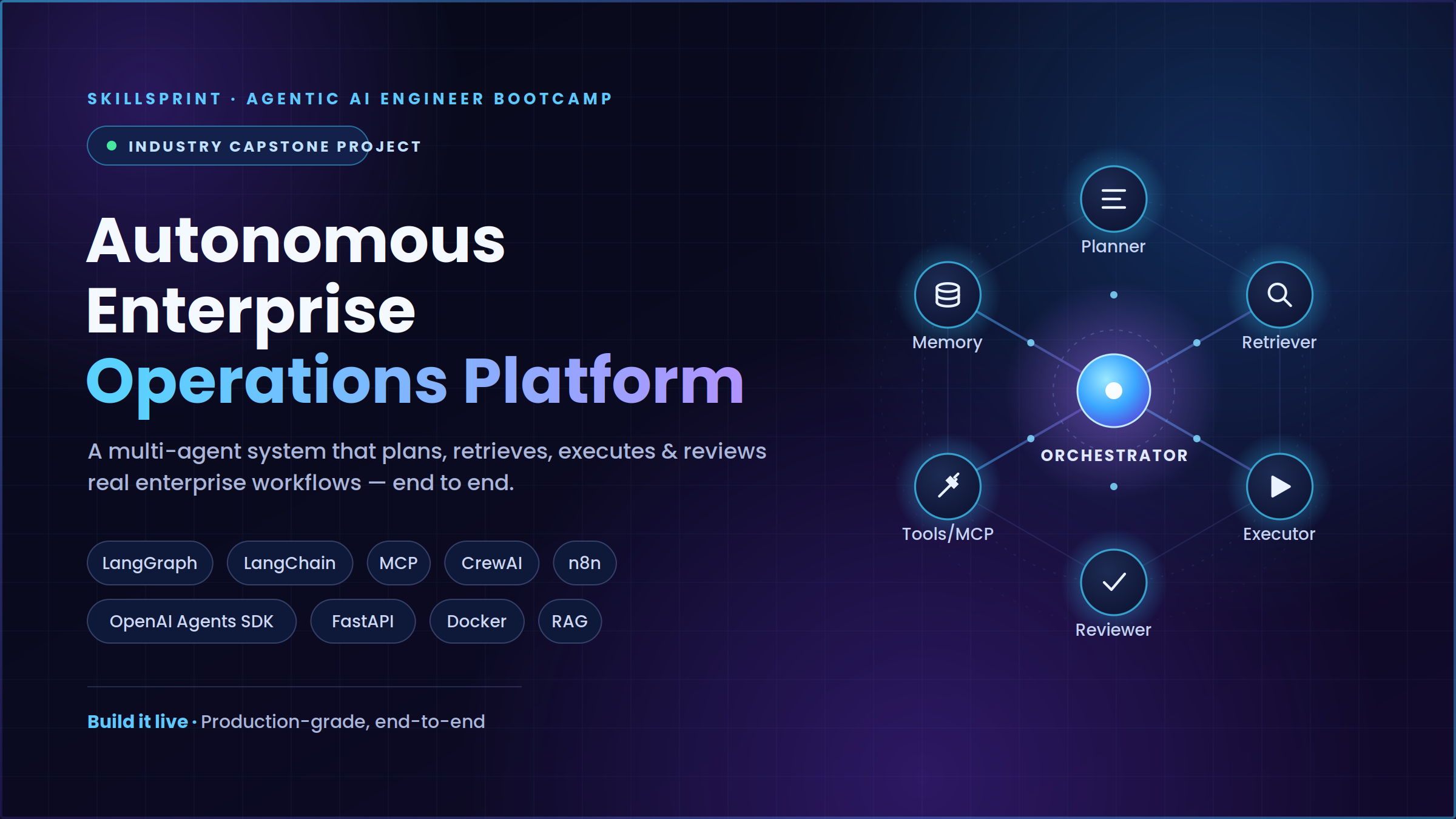
Autonomous Enterprise Operations Platform
Agentic AI Engineer Bootcamp
What our Students Say
Real people. Real results.
-

I recently completed the Agentic AI bootcamp with SkillSprint, and it was a great learning experience. The instructor explained all the concepts in a very simple and practical way, making even complex topics easy to understand. The teaching style was interactive and hands-on. If you're looking for the best Agentic AI classes near Hinjewadi, Pune, I highly recommend SkillSprint.
Rahul Chaudhary

-
I had an excellent learning experience with the SkillSprint Tech Agentic AI course. The teaching approach is practical, industry-focused, and very easy to understand. Skill Tech is one of the best AI training institutes in Hinjewadi, Pune. They also provide great certification guidance, making it one of the best training centres in Hinjewadi for aspiring AI professionals.
Neha Arora
-
SkillSprint Tech is one of the best IT training institutes in Pune. The trainers focus on practical learning, live projects, and interview preparation. If anyone is looking for a job-oriented technical course in Pune with placement assistance, I would definitely recommend this institute.
Sumit Saxena
Frequently Asked Questions

Interested in this course?
Talk to a mentor for free — no commitment, no pressure. Just clarity.